






How to Choose the Best Products for Stadium Crowd Control

Nick Criscuolo, May 29, 2026
Read more about the author


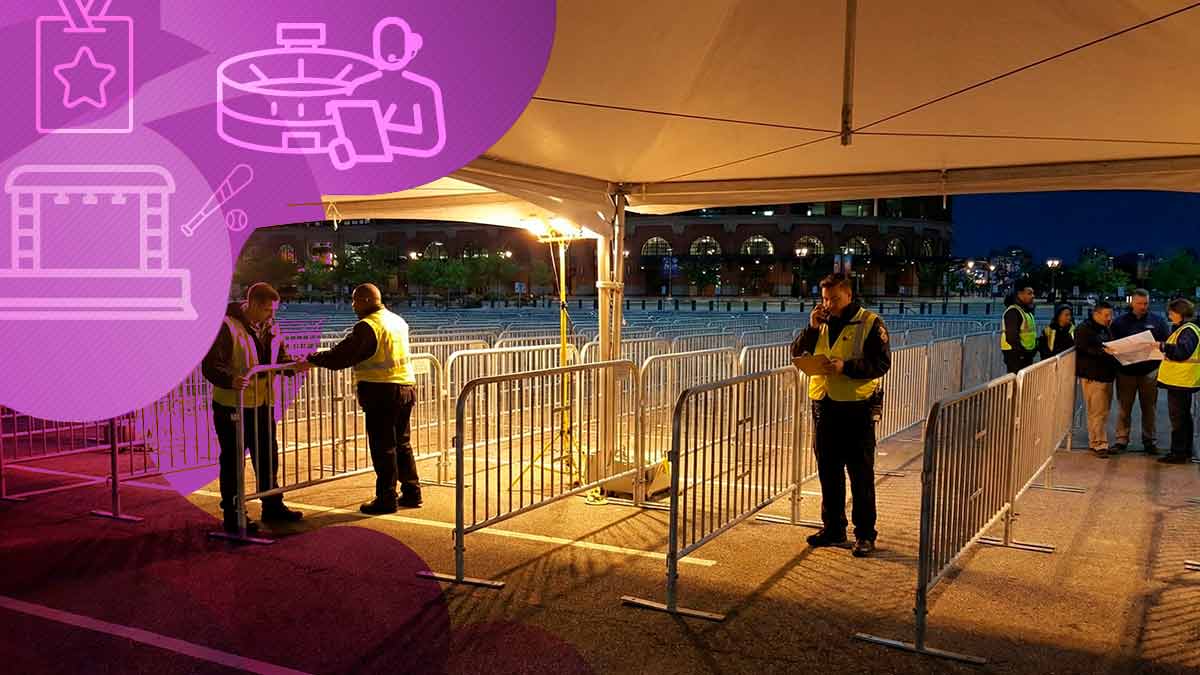
Managing tens of thousands of people in a confined space is one of the most complex logistical challenges in the events industry. Whether you are running a sold-out NFL game, a college football playoff, or a major international soccer match, the decisions you make about crowd flow, barrier placement, and perimeter management directly affect safety outcomes, fan experience, and your legal liability.
In this content, we will walk through best practices, what actually makes a product worth the investment, and which specific solutions tend to perform best in high-density stadium environments.
Key Takeaways:
- Crowd control at stadiums is a system, not a single product. Steel barricades belong at field perimeters and stage fronts, aluminum complements them in moderate-pressure zones, and event fencing performance comes down to panel density, foot weight, and connection type. For plastic barricades, full ballast and corridor clearance mapping are non-negotiable before deployment.
- The right product in the wrong zone is still the wrong decision. Map pressure levels first, then match equipment to each zone accordingly.
What are the best practices for stadium crowd control?
Before you even think about which products to buy, the foundation of effective crowd management lies in planning and process. Equipment is only as effective as the strategy behind it.
- Map your crowd flow before the event. Identify where bottlenecks naturally form: entry gates, concession areas, restrooms, and exit corridors. A well-placed barrier in the right location reduces pressure on staff and minimizes the risk of crowd crush. Understanding what crowd control really means in an operational context, not just in theory, helps teams treat it as a system rather than an afterthought.
- Design for both entry and emergency exit. Many venues over-optimize for ingress and leave egress underplanned. Your barriers, stanchions, and fencing configurations must be reversible or removable quickly in an emergency scenario.
- Train your staff on barrier setup and crowd reading. Physical tools are only effective when the people deploying them understand crowd dynamics. Staff should know how to recognize early signs of crowd pressure buildup and adjust configurations in real time.
- Segment your crowd by zone. VIP areas, general admission standing zones, and family sections have different behavioral profiles. Treating them with the same crowd control setup leads to friction. Dedicated configurations per zone improve both safety and the fan experience.
- Plan for high-attendance anomalies. Record attendance events create conditions that routine planning does not prepare for. The 107th Indianapolis 500, for example, drew historic crowd sizes and television ratings, serving as a reminder that when events exceed expectations, unprepared venues face exponentially higher risk. Having scalable, modular crowd control infrastructure that can be expanded quickly is not optional at that level, it is essential.
What Makes a Crowd Control Product Right for Stadium Use?
Not all barriers and crowd control equipment are created equal.
For stadium and large venue applications, the standard for what qualifies as the right product is significantly higher than for retail queues or indoor corporate events.
Here is what actually separates effective stadium-grade equipment from everything else:
- Durability under sustained pressure. Stadium crowds generate continuous lateral force against barriers, especially near the field, the stage front, or any high-demand access point. A product built for this environment holds its position under that load without collapsing or shifting. Equipment designed for lighter indoor applications will not survive a sold-out game day in those zones.
- Ease of configuration and reconfiguration. Venues do not run one event per year. They run dozens per season, often with entirely different floor plans, zone structures, and capacity limits. Products that are slow to assemble, awkward to store, or difficult to adjust become operational liabilities over time. Modular systems with interlocking or connectable designs reduce setup time, lower labor costs, and give your team real flexibility between events.
- Visibility and brand compatibility. Crowd control equipment sits directly in the sightlines of thousands of fans, broadcast cameras, and sponsors on every event day. Products that support custom covers, branded panels, or sponsor messaging turn an operational necessity into a revenue opportunity. The value of barricade covers tends to be underestimated until venues actually calculate what that perimeter real estate is worth during a capacity event.
- Compliance with public assembly safety standards. Any product deployed in a stadium environment should meet applicable load-bearing, fire resistance, and material safety requirements.
- Verify certifications before committing to a large purchase. This is not an area where assumptions are acceptable.
- Vendor reliability and supply chain depth. A strong product backed by a weak supplier creates risk. When you need additional units before a major event, replacement parts mid-season, or a custom configuration on short notice, your vendor needs to be able to deliver. Responsiveness and inventory depth are part of the product evaluation, not an afterthought.
Best Podructs for Crowd Control at Stadium
Metal Barricades
Metal barricades are the workhorses of stadium crowd control. Typically constructed from galvanized steel or aluminum, they are engineered to absorb sustained lateral crowd pressure in standing-room-only zones, field-adjacent areas, and high-volume entry points.
Standard units run between 6 and 8 feet in length, but what separates stadium-grade options from lighter alternatives is wall thickness, foot plate design, and connection system.
Interlocking side-rail systems distribute force across the entire barrier run, while pin-connected systems deploy faster and suit gate queue configurations better.
On the other hand, steel units, typically between 35 and 60 pounds per section, are the right call for field perimeters and stage fronts where crowd pressure peaks.
Aluminum barricades are lighter and easier to reposition between events, making them a smart complement for moderate-pressure zones.
Venues that maintain both in inventory and deploy based on zone risk level get the best of durability and operational flexibility without compromising safety where it matters most.
Event Fencing
Event fencing defines perimeters, controls venue access, and creates temporary boundaries around outdoor footprints like parking activations, tailgate zones, and sponsor areas.
Standard panels run 6 feet tall by 10 to 12 feet wide, but the more consequential decision is panel density. Open chain-link panels maintain sightlines for crowd monitoring across the perimeter, while solid steel panels suit restricted backstage or credentialed zones where visual separation is the priority.
Foot weight is the spec that gets underestimated until a panel goes down. Rubber-base feet between 25 and 35 pounds work in low-pressure conditions, but exposed outdoor stadiums or high-attendance perimeters need concrete block feet or cross-brace support.
On connection type, clamp systems hold under lateral force significantly better than hook connections, which can disengage under crowd pressure or wind load.
Plastic Barricades
Plastic barricades come in two main formats: water-fillable channeling units, typically 3 to 4 feet tall and 3 to 6 feet long, and lighter hollow-core pedestrian barriers around 40 inches tall.
For vehicle exclusion zones, water-fillable units are the right call, but fill level determines performance. Most require full capacity, between 30 and 50 gallons, to meet their stability rating
Partially filled units under lateral contact become a liability rather than a solution.
For indoor concourse applications, base width is the measurement that matters most. A unit with a 24-inch base in a 12-foot corridor consumes far more usable width than the panel itself suggests.
Map your corridor clearances and peak bidirectional flow before selecting a profile, or you will create the exact bottleneck you were trying to prevent.
Displays and Signage Systems
Digital and static display systems positioned at key decision points, entry gates, concourse intersections, and seating area transitions help reduce crowd bunching by giving attendees the information they need to self-direct.
When fans know where their section is, where the nearest restroom is, or that a particular gate is at capacity, they move with purpose rather than hesitation. Hesitation is where bottlenecks begin.
For venues with large sponsorship programs, display systems integrated into crowd control infrastructure also create monetization opportunities. Branded panels, LED displays, and backlit signage systems can carry sponsor messaging while simultaneously performing a functional wayfinding or crowd management role.
Displays also matter from an emergency communication standpoint. Venues with integrated display networks can push real-time messaging to critical locations faster than any announcement system, which is a genuine safety advantage in dynamic situations.
Which Stadium Crowd Control Product Fits Each Situation?
| Product Category | Best Use Cases |
| Metal Barricades | Field perimeters, stage fronts, high-pressure queue zones, entry gate management |
| Event Fencing | Venue perimeter control, outdoor activation areas, tailgate zones, unauthorized access prevention |
| Plastic Barricades | Vehicle exclusion zones, indoor concourse flow, moderate-pressure areas, temporary reconfiguration needs |
| Displays and Signage | Wayfinding, emergency communication, sponsor integration, entry and seating direction |
SONCO at Stadiums: Taking Good Care
The right combination of products does not just make your event safer. It makes it more professional, more efficient, and more profitable. Venues that treat crowd control infrastructure as a strategic investment rather than a compliance checkbox consistently outperform those that do not, in fan satisfaction, in incident reduction, and in operational efficiency over a full season.
SONCO's full range of crowd control barriers and stadium solutions is designed specifically for the demands of large-scale public assembly events. From metal barricades built for sustained lateral loads to modular fencing systems that deploy in minutes, every product in the lineup is built around the real-world conditions that stadium and venue teams face.
If you are evaluating your current setup or preparing for an upcoming season, the best next step is to map your venue's highest-risk zones against the product categories above and identify the gaps.
SONCO's team is available to help you build a configuration that fits your specific layout, attendance profile, and budget.
Reach out today and make sure your next event is one where the crowd remembers the experience, not the incident.
Trend now

Temporary Fence Rental Lifespan: Tips to Make Your Fence Last Longer
Learn the storage habits that extend the lifespan of every panel.

How to Manage a Crowd at an Event: A Complete Guide for Event Managers
Learn how to manage a crowd at an event with proven strategies for planning, signage, barriers, staffing and more.

How to Install a Mesh Chain-Link Fence: Step-by-Step Guide
Learn how to install a mesh chain-link fence step by step.
Search for category
Request a quote now! 