


How to Choose Metal Barricades? Which One Is Best?

Andrew Hession, September 8, 2022
Read more about the author


Metal barricades are interlocking steel barriers used to manage crowds, direct pedestrian traffic, and establish temporary perimeters at events, construction sites, and public gatherings. Their strength, reusable design, and modular connections make them a dependable choice when organizers need clearly defined boundaries and controlled access.
Choosing the right metal barricade depends on your application, crowd conditions, barrier height, steel gauge, finish, and feet configuration. SONCO's S-series metal barricades offer options for different crowd management and perimeter requirements.
In this guide, you'll learn how metal barricades work, where to use them, how to compare models, and what to consider before purchasing.
Key Takeaways
- Metal barricades create temporary boundaries: Use them to direct pedestrian traffic, manage queues, restrict access, and establish event or construction perimeters.
- Choose a model based on your application: Lightweight, standard, heavy-duty, super heavy-duty, and extra-tall barricades serve different operational needs.
- Compare steel gauge, dimensions, and weight: These specifications help you evaluate the construction and handling requirements of each model.
- Consider feet and finishes: The right configuration can make deployment, storage, and routine handling easier.
Why Choose Metal Barricades for Crowd Control & Pedestrian Use?

Metal barricades are a practical choice for event producers, facility managers, construction teams, rental companies, and public-sector organizations that need temporary pedestrian control.
Their steel construction and interlocking design help establish physical boundaries in busy environments. When properly selected and deployed, they can help direct foot traffic, discourage unauthorized access, protect restricted areas, and create more organized pedestrian routes.
Metal barricades also communicate where people should and should not go. A clearly defined perimeter gives attendees, workers, and visitors a visible indication of access restrictions and expected movement.
Common applications include:
- Concerts, festivals, and sporting events
- Queue management at venues and public attractions
- Pedestrian routes around construction activities
- Restricted-access areas and backstage perimeters
- Public gatherings and municipal events
- Temporary enclosures around equipment and materials
Important: Standard metal crowd control barricades are not a substitute for engineered vehicle barriers, fall protection, or jobsite perimeter fencing where those systems are required. Select equipment according to the hazards and access-control needs of your site.
Explore SONCO's metal barricades to compare available models and configurations.
What Are the Different Types of Metal Barricades?
Metal barricades vary in construction, dimensions, weight, finish, and intended application. Understanding these differences helps you select equipment that matches your operational needs.
SONCO organizes its metal barricade lineup into five main S-series categories.
|
Barricade type |
Model |
Key considerations |
|
Lightweight |
S-100 |
Consider for frequent layout changes, indoor events, and pedestrian guidance. |
|
Standard |
S-200 |
Consider for general crowd management at venues and public events. |
|
Heavy-duty |
S-400 and S-500 |
Consider for concerts, festivals, and demanding crowd management applications. |
|
Super heavy-duty |
S-300 |
Consider for high-traffic gatherings and applications requiring a heavier-gauge steel frame. |
|
Extra-tall |
S-600 |
Consider when additional barrier height is needed for perimeter control. |
These categories are a starting point, not a substitute for reviewing the specifications of the individual product. Confirm the model's dimensions, weight, gauge, feet, and finish before ordering.
Lightweight Metal Barricades
Lightweight metal barricades are worth considering when crews need to move, install, and rearrange barriers frequently. Their lower handling weight can help simplify setup and breakdown for temporary layouts.
Potential applications include indoor events, queue lines, schools, and pedestrian guidance.

Standard Metal Barricades
Standard metal barricades are suited to general crowd management at public gatherings and venues. They provide a familiar interlocking format for creating pedestrian routes, separating queues, and defining event boundaries.
Consider the expected crowd conditions and the frequency of deployment when comparing standard models.

Heavy-Duty Metal Barricades
Heavy-duty metal barricades are designed for demanding applications where construction and durability are important selection factors.
They can be considered for concerts, festivals, street events, and other high-traffic environments. Compare steel gauge, overall dimensions, feet configuration, and handling requirements before selecting a model.

Super Heavy-Duty Metal Barricades
Super heavy-duty models use a heavier-gauge steel construction than standard lightweight models. They may be appropriate for demanding public gatherings, rental inventories, and applications that require robust equipment.
The specific model and site conditions should determine whether a super heavy-duty barricade is appropriate.
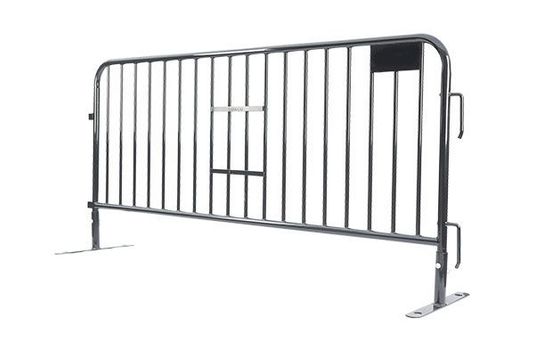
Extra-Tall Metal Barricades
Extra-tall metal barricades provide additional height compared with standard crowd control models. They may be useful for construction perimeters, industrial facilities, backstage areas, and other locations where a taller temporary boundary is needed.
Extra height alone does not establish that a barricade meets a particular security or fall-protection requirement. Verify suitability for the intended application.
How to Choose the Right Metal Barricade
Before purchasing metal barricades, evaluate the operating environment, intended use, and practical requirements of the people who will handle the equipment.
1. Define the Application
Start by identifying what the barrier needs to accomplish.
Queue management: Prioritize practical handling and layouts that can be adjusted as attendance changes.
Concerts and festivals: Consider crowd conditions, perimeter configuration, and the expected frequency of deployment.
Construction sites: Determine whether the primary need is pedestrian guidance, restricted access, or a separate perimeter protection system.
Public-sector events: Consider crowd flow, access points, and the ability to establish consistent boundaries.
Rental fleets: Evaluate durability, storage requirements, handling, and the needs of the customers who will use the equipment.
The application should guide your model selection rather than price alone.
2. Compare Steel Gauge, Weight, and Dimensions
Steel gauge is one factor to consider when comparing metal barricades. In the U.S. gauge system, a lower gauge number generally indicates thicker sheet steel. However, gauge alone does not establish the overall strength of a finished barricade.
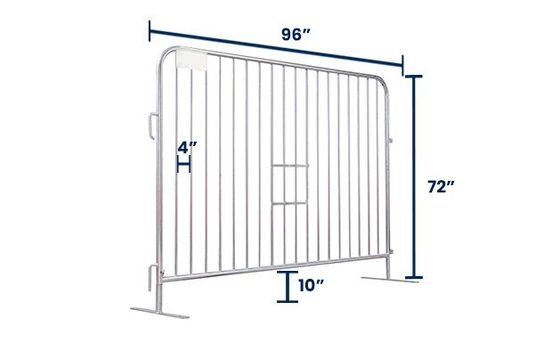
Also compare the barrier's length, height, weight, frame construction, welds, and feet.
Weight matters operationally, too. Lighter models can be easier to reposition, while heavier models may be preferable for applications that call for more substantial construction. Neither weight nor gauge alone guarantees performance under a particular crowd load.
3. Choose the Right Finish
The finish affects the appearance and maintenance requirements of your barricades.
Hot-dip galvanized finish: Steel is coated with zinc to help protect against corrosion. This finish is worth considering for outdoor applications where exposure to moisture is a concern.
Powder-coated finish: A colored coating provides a finished appearance and can help make barriers more visually distinctive. Color options may be useful for event branding, operational organization, or visibility.
Check each product listing for available finishes and colors. Not every finish is available on every model.
4. Evaluate the Feet Configuration
Feet affect how barricades sit on the ground, how people move around them, and how easily crews can transport and store them.
Depending on the model, options may include:
- Flat feet: A low-profile design that can help reduce tripping hazards around the base.
- Bridge feet: A raised profile that may be useful where pedestrian movement over the base is a consideration.
- Detachable feet: Removable bases that can help simplify stacking, transportation, and storage.
- Foot options vary by product. Evaluate the surface, pedestrian traffic, storage space, and handling requirements before making a selection.
5. Consider Installation and Storage
Interlocking barricades can be arranged in straight lines, enclosures, and other temporary layouts. Before ordering, estimate the perimeter length and identify corners, entry points, and areas where the configuration may change.
For larger inventories, consider how barricades will be stacked, transported, and stored between uses. Detachable feet and compatible transportation carts may help streamline these tasks.

6. Plan for Access and Safety
A continuous barrier line can help direct movement, but some layouts also require designated access points for staff, pedestrians, or authorized personnel.
Plan openings and entry routes before installation. Inspect the equipment for damaged frames, loose connections, or compromised feet, and follow the manufacturer's setup instructions.
Do not assume that a standard metal barricade can withstand vehicle impact or safely contain a dense crowd surge. Choose equipment specifically suited to the identified hazard.
Frequently Asked Questions About Metal Barricades
What is a bike rack barricade?
A bike rack barricade is a type of interlocking metal crowd control barrier. The name comes from its vertical openings, which resemble the slots in bicycle racks. These portable steel barriers connect to create continuous lines or temporary enclosures.
What is the difference between hot-dip galvanized and powder-coated metal barricades?
Hot-dip galvanizing applies a zinc coating that helps protect steel from corrosion. Powder coating provides a colored finish and can also contribute to surface protection. The best choice depends on the operating environment, appearance requirements, and available product configurations.
Can metal barricades be connected to form a larger perimeter?
Yes. Conventional interlocking metal barricades connect through hooks and loops to create longer barrier lines, pedestrian routes, and temporary enclosures. Plan the layout before installation, including corners, entry points, and access routes.
Choose the Right Metal Barricades for Your Next Project
The right metal barricade depends on more than its price or appearance. Application, steel gauge, dimensions, finish, feet, handling requirements, and the intended level of separation all matter when comparing models.
SONCO's S-series lineup provides options for different crowd control and pedestrian management needs. Review the available models and configurations to find equipment that fits your operational requirements.
Explore SONCO's metal barricades to compare models, finishes, and feet options.
Trend now

Temporary Fence Rental Lifespan: Tips to Make Your Fence Last Longer
Learn the storage habits that extend the lifespan of every panel.

How to Manage a Crowd at an Event: A Complete Guide for Event Managers
Learn how to manage a crowd at an event with proven strategies for planning, signage, barriers, staffing and more.

How to Install a Mesh Chain-Link Fence: Step-by-Step Guide
Learn how to install a mesh chain-link fence step by step.
Search for category
Request a quote now! 