






Yodock Barriers: The Buyer's Guide to Solving Your Biggest Site Challenges

Andrew Hession, August 12, 2022
Read more about the author


Choosing the right barrier for your site shouldn't mean guessing. Yodock water-filled barriers are one of the most trusted alternatives to concrete Jersey barriers since, they are easy to transport, fast to deploy, and MASH-compliant for roadway and construction use.
However, not every Yodock model solves the same problem.
This guide walks through the most common site challenges we hear from customers and matches each one to the right barrier setup, so you can spec your project with confidence.
Keep reading!
How to Know If Your Project Needs a Yodock Barrier
Most projects don't start with "I need a Yodock barrier." They start with a problem that needs an efficient, cost-effective solution.
If any of the situations below sound familiar, it's a strong sign a Yodock barrier is the right fit for your site.
Your Crew Can't Wait on a Crane Just to Move a Barrier
Concrete barriers require heavy equipment to place, reposition, or remove, which slows down projects, adds rental costs, and introduces risk any time machinery is on site.
Yodock barriers solve this with a genuinely two-person deployment. They ship light and empty, so your crew sets them in place by hand, then fills them with water or sand once positioned for full ballasted weight. No crane, no forklift required for standard placement (though forklift-compatible options exist for larger jobs).
In this way, construction crews cut down on equipment rental costs and setup time, while rental fleets can redeploy barriers to a new site the same day without scheduling a crane.

Freeze-Thaw Cycles Are Cracking Your Concrete Barriers
Concrete absorbs moisture. Once winter hits, that moisture freezes, expands, and cracks the barrier from the inside out, meaning replacement costs show up every few years, right when you need the barrier most.
Yodock barriers are built from high-density polyethylene (HDPE), a material that doesn't crack, corrode, or degrade the way concrete does.
For barriers filled with water, we still recommend mixing in an anti-freeze agent or switching to sand ballast in freezing climates, but the barrier shell itself holds up season after season.
At the end, municipal and DOT teams get a barrier fleet that survives winter after winter instead of budgeting for annual concrete replacement. A real difference for agencies managing barriers across multiple sites and seasons.

Compliance Holdups Are Delaying Your Project Approval
If your project sits near active traffic, the barrier you use isn't just a safety choice — it's a permitting requirement. Barriers that aren't crash-tested can get a project rejected outright, or expose your team to liability if something goes wrong.
Yodock barriers are MASH-tested (TL-2 and TL-3 configurations, depending on model) and FHWA-accepted for use as longitudinal channelizing devices in approved configurations. That means the documentation is already there when your project engineer or permitting office asks for it.
With this solution, public sector buyers and general contractors move through permitting faster because the compliance documentation is already on hand, instead of chasing it down mid-project or risking a rejected approval.
Your Event Site Needs to Look Good, Not Just Be Safe
A construction-grade barrier line can feel out of place at a public-facing event . In must cases, attendees notice when a perimeter looks industrial instead of intentional.
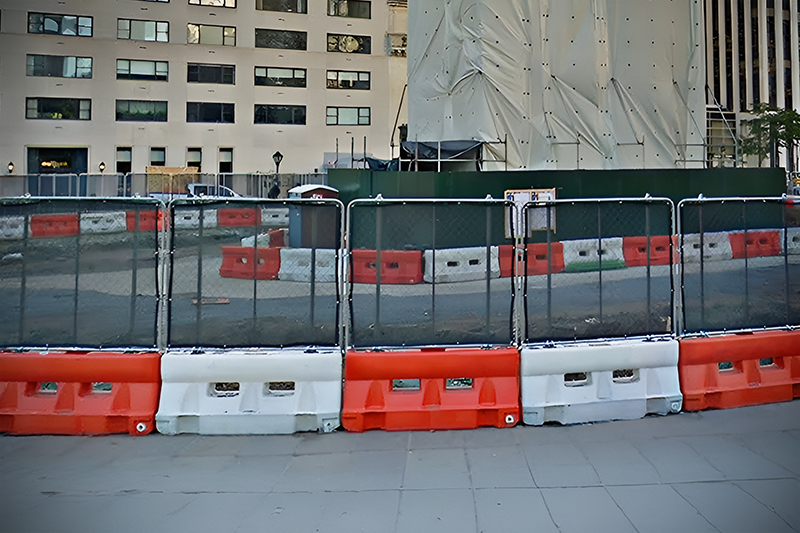
Yodock barriers support fence topper panels, mesh, and branding accessories that dress up the barrier line without compromising its function as a crowd or vehicle control line. You still get a certified, ballasted barrier. It just looks like it belongs at your event.
This is how event producers and venue operators get a perimeter that reads as intentional design rather than a construction leftover, without giving up certified crowd and vehicle protection.
Renting Barriers Every Season Is Eating Into Your Margin
If you're running a rental fleet, every barrier that cracks, warps, or needs early replacement is a direct hit to your margin.
Because Yodock barriers are built from heavy-duty HDPE rather than concrete, they hold up to repeated loading, transport, and impact far longer, which means fewer replacements per season and a stronger resale position when it's time to refresh your fleet. They're also stackable, so storage between rentals takes up less yard space.
Rental companies protect their margin with fewer replacements per season and a fleet that holds resale value, plus stackable storage that frees up yard space between jobs.
Yodock 2001M vs. 2001MB: Which Model Fits Your Job?
The two most commonly specified Yodock models solve slightly different problems:
| Yodock 2001M | Yodock 2001MB | |
| MASH Rating | TL-2 | TL-2 |
| Weight (filled) | Up to ~900 lbs | Up to ~900 lbs |
| Best for | Continuous perimeters, public events, temporary road closures | Vertical construction, job site security, urban perimeters |
| Standout feature | Interlocking sections for long continuous runs | Pre-molded fence panel openings for a 66" combined barrier + fence height |
Both models deploy at roughly 85 lbs empty for easy two-person handling, and both accept fence toppers and corner connectors for custom layouts. If your priority is a long, continuous line (think event perimeters or lane separation) the 2001M is usually the better starting point. If you need the barrier to double as the base for a job site fence line, the 2001MB is purpose-built for that.
Common Mistakes Managers Make Before Buying Water Barriers
Even with the right barrier in mind, a few common missteps can undercut safety and value before the barrier ever hits the ground:
- Buying on price alone: choosing cheap, non-certified water-filled barriers that aren't MASH-tested or FHWA-accepted, which can put a project's approval and safety record at risk.
- Skipping ballast when it's actually required: deploying barriers empty or under-filled gives a false sense of security; without water, sand, or ground-mounting, a barrier can't do its job in a real impact or crowd scenario.
- Ignoring weather planning: not mixing in anti-freeze for cold climates (or switching to sand) leads to cracked barriers and shortened lifespan, turning a one-time purchase into a recurring cost.
Avoiding these three mistakes is often the difference between a barrier that performs for years and one that needs replacing after a single season.
Ready to Spec Your Project?
Not sure which configuration fits your site? Browse the full Yodock lineup or request a quote and our team will help you choose the right model, ballast option, and accessories for your specific use case.
Trend now

Temporary Fence Rental Lifespan: Tips to Make Your Fence Last Longer
Learn the storage habits that extend the lifespan of every panel.

How to Manage a Crowd at an Event: A Complete Guide for Event Managers
Learn how to manage a crowd at an event with proven strategies for planning, signage, barriers, staffing and more.

How to Install a Mesh Chain-Link Fence: Step-by-Step Guide
Learn how to install a mesh chain-link fence step by step.
Search for category
Request a quote now! 