






Metal Barricade Applications: From Events to Public Spaces and More

Nick Criscuolo, February 13, 2026
Read more about the author


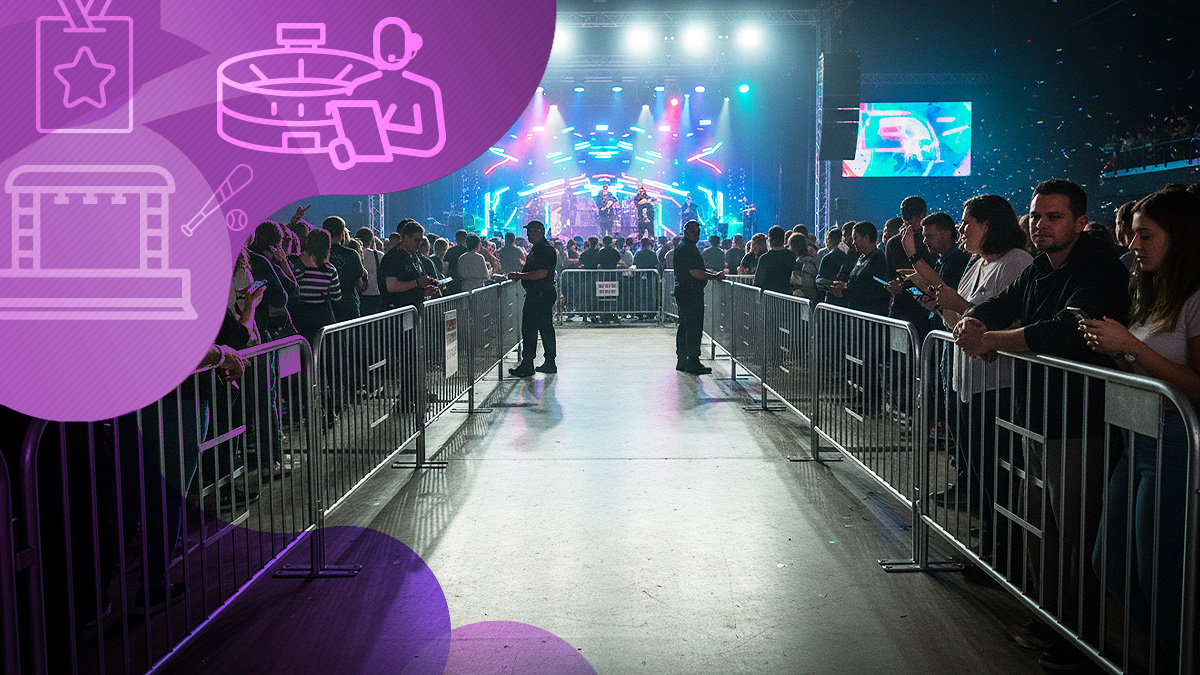
Metal barricades show up almost everywhere crowds gather, concert entrances, marathon routes, protest perimeters, construction sites, even grocery store queues. But a barricade that works well for a hospitality entry lane isn't necessarily the right choice for a street closure or a high-density protest.
Weight, base type, finish, and mobility all change depending on where and how the unit is deployed.
This guide breaks down the most common metal barricade applications, compares configuration options side by side, and walks through how to choose (and size) a barricade setup for your specific environment.
Metal barricades are used to control pedestrian flow, define secure perimeters, and manage crowd density in settings like events and venues, municipal street closures, protests, construction zones, and rental operations.
The right configuration depends on five factors: crowd density, indoor vs. outdoor exposure, how often the barricades are repositioned, the base type, and the finish's corrosion resistance.
Key Takeaways
- Events and venues typically favor lighter, easy-to-reposition barricades for indoor lanes, and heavier-duty units for large outdoor crowds.
- Municipal and public sector use prioritizes outdoor stability, fast deployment, and repeat use across many events.
- Protests and high-density crowds call for reinforced, heavy-duty barricades built for controlled separation under pressure.
- Rental companies need durable, stackable units that hold up to frequent setup, breakdown, and transport.
Common Metal Barricade Applications
Metal barricades are deployed in different environments depending on crowd behavior, movement patterns, and operational needs. While the structure looks similar across models, the right choice depends on how the barricades will actually be used on site.
Below are the most common deployment environments reflected in the comparison table.
Events & Venues
For events, like conferences, arenas, festivals, and hospitality venues use barricades to create controlled entry lanes, manage queue lines, and separate access zones.
Priorities here include visual presentation, easy repositioning during the event, and keeping pedestrian flow moving without bottlenecks. Lighter configurations often work fine for indoor control lanes, while outdoor gatherings with larger crowds tend to call for heavier-duty units.
Municipal & Public Events
Cities and municipalities deploy metal barricades for parades, street closures, civic events, and temporary traffic redirection. The priorities shift toward outdoor stability, fast deployment by public works crews, and durability across repeated use. Most agencies lean toward heavy-duty barricades that can handle frequent handling and long-term storage.
Protests & High-Density Crowds
Large crowds and protest scenarios demand barricades built to manage pressure and hold a secure perimeter. Crowd density is higher, law enforcement is often involved, and reinforced, heavy-duty units are the standard choice. The goal in these situations is controlled separation — not simple lane guidance.
Rental & Repeated Deployment
Rental companies and venues hosting frequent events need barricades built for durability and stackability. Frequent setup and takedown cycles demand consistent structural integrity, efficient storage, and reliable performance over time — which is why heavy-duty models are the common pick for this use case.
Public Spaces & Access Control
Beyond large-scale events, metal barricades are also used for everyday access control — construction site perimeters, retail queue management, and temporary pedestrian redirection around public spaces. These applications generally call for a balance between visibility, easy handling by a small crew, and moderate durability, since units are often moved short distances rather than transported long-term.
Application Comparison Table
| Application | Typical Setting | Weight Preference | Base Type Priority | Finish | Repositioning Frequency |
| Events & Venues | Indoor/outdoor | Light (indoor) to heavy (outdoor) | Bridge feet, flat feet | Powder-coated or galvanized | High |
| Municipal & Public Events | Outdoor | Heavy-duty | Flat feet, bolt-down | Galvanized | Moderate |
| Protests & High-Density Crowds | Outdoor | Heavy-duty, reinforced | Bolt-down, weighted bases | Galvanized | Low |
| Rental & Repeated Deployment | Indoor/outdoor | Heavy-duty | Stackable bridge feet | Galvanized | Very high |
| Public Spaces & Access Control | Indoor/outdoor | Light to moderate | Flat feet | Powder-coated | Moderate |

How to Choose a Metal Barricade
Selecting the right metal barricade means looking past the environment alone and evaluating how the unit will actually be handled, exposed, and stored over time.
Crowd Density
Light pedestrian guidance calls for a different setup than dense or high-pressure crowd control. Higher density generally means heavier, more reinforced units to hold a line under pressure.
Indoor vs. Outdoor
Indoor deployments typically need only lighter corrosion protection since they're used in controlled environments. Outdoor use introduces rain, humidity, temperature swings, and surface instability — galvanized or powder-coated finishes are the standard for outdoor longevity.
Mobility & Setup Frequency
Heavier barricades provide greater stability in dense crowd conditions, but lighter units are easier to reposition and transport. The right balance comes down to whether stability or flexibility matters more for your event cadence.
Base Type & Stability
Different base configurations affect footprint, trip risk, and storage efficiency. Fixed bridge feet, flat feet, and bolt-down options each serve different needs depending on the surface type and available space.
Finish & Corrosion Resistance
Finish affects both durability and appearance. Galvanized finishes offer strong corrosion resistance for repeated outdoor use, while painted or powder-coated options can support branding or a consistent visual look across a venue.
Storage & Transportation
Frequent movers — rental companies, venues, and public works crews — should weigh how easily units stack, nest, or load onto a truck. Efficient storage reduces labor time and prevents damage between deployments.
Which Metal Barricade Should You Choose?
Use these quick guidelines to narrow down a configuration:
- Select lightweight units if you're managing indoor queue lines with frequent repositioning and low crowd pressure.
- Opt for heavy-duty, galvanized units if you're deploying outdoors, repeatedly, or in high-density crowd conditions.
- Use bolt-down or weighted bases if wind exposure or crowd pressure is a concern and the barricades will stay in place for an extended period.
- Go with stackable, bridge-foot models if storage space and transport efficiency are a priority, as with rental fleets.
- Consider powder-coated finishes if brand visibility or a polished public-facing appearance matters alongside durability.
How Many Metal Barricades Do You Need?
A simple way to estimate barricade count:
- Measure the perimeter or lane length you need to cover, in linear feet.
- Divide by the barricade panel length (most standard metal barricades run 6.5 to 8 feet per panel).
- Add 10–15% extra for corners, gates, overlaps, and staging/backup units.
- Factor in crowd density — for high-density or protest-level crowds, consider reinforcing key pressure points (entrances, stage fronts, chokepoints) with additional or heavier units rather than just extending the line.
For example, a 300-foot perimeter using 7.5-foot panels needs roughly 40 panels, plus a buffer of 4–6 additional units for corners and contingencies.

When Should You Use a Metal Barricade?
Metal barricades aren't the right tool for every scenario. Here's how they compare to other common solutions:
| Solution | Best For | Limitations |
| Metal barricades | Crowd control, perimeter security, queue management, short-to-medium term deployments | Heavier to transport than plastic alternatives |
| Plastic/water-filled barriers | Traffic redirection, long-term low-security perimeters | Lower crowd-pressure resistance |
| Chain-link fencing | Extended perimeter security, construction sites | Slower to install/remove, less mobile |
| Rope and stanchions | Light indoor queue guidance, low-pressure settings | Minimal physical barrier, easy to breach |
Metal barricades are generally the right call when you need a visible, mobile, and physically resistant barrier that can be deployed quickly and reused across multiple events.
Frequently Asked Questions About Metal Barricades
What is the standard length of a metal barricade panel?
Most standard metal crowd control barricades measure between 6.5 and 8 feet in length, though custom lengths are available for specific applications.
Are metal barricades better than plastic barricades for outdoor events?
For outdoor events involving wind exposure or larger crowds, metal barricades generally offer more stability and durability than lightweight plastic alternatives, particularly with a galvanized or powder-coated finish.
Can metal barricades be used indoors?
Yes. Indoor deployments typically use lighter-weight metal barricades with basic corrosion protection, since they aren't exposed to weather.
How much does a metal barricade weigh?
Weight varies by model, but standard crowd control barricades typically range from 25 to 45 pounds per panel, with heavier-duty models exceeding that for high-density or outdoor use.
Do metal barricades need to be bolted down?
Not always. Bolt-down bases are typically reserved for permanent or semi-permanent installations, or situations with significant wind exposure or crowd pressure. Most event and rental applications use freestanding bridge or flat-foot bases instead.
How do rental companies maintain metal barricades between events?
Rental companies typically inspect for structural damage, clean off debris or corrosion, and store units in stackable configurations to protect the finish and reduce wear between deployments.
How SONCO Supports Metal Barricade Projects
For 50 years, SONCO has supplied safety and crowd control equipment to venues, municipalities, and event operators across the country.
We maintain in-stock metal barricade models in multiple configurations and support fast shipping for projects with short deployment timelines.
If you need help matching a barricade type to your environment, comparing configurations, or confirming availability, you can contact our team to discuss your specific application.

Trend now

Temporary Fence Rental Lifespan: Tips to Make Your Fence Last Longer
Learn the storage habits that extend the lifespan of every panel.

How to Manage a Crowd at an Event: A Complete Guide for Event Managers
Learn how to manage a crowd at an event with proven strategies for planning, signage, barriers, staffing and more.

How to Install a Mesh Chain-Link Fence: Step-by-Step Guide
Learn how to install a mesh chain-link fence step by step.
Search for category
Request a quote now! 