


Stability Configurations: From Basic to High-Wind

Andrew Hession, August 14, 2026
Read more about the author


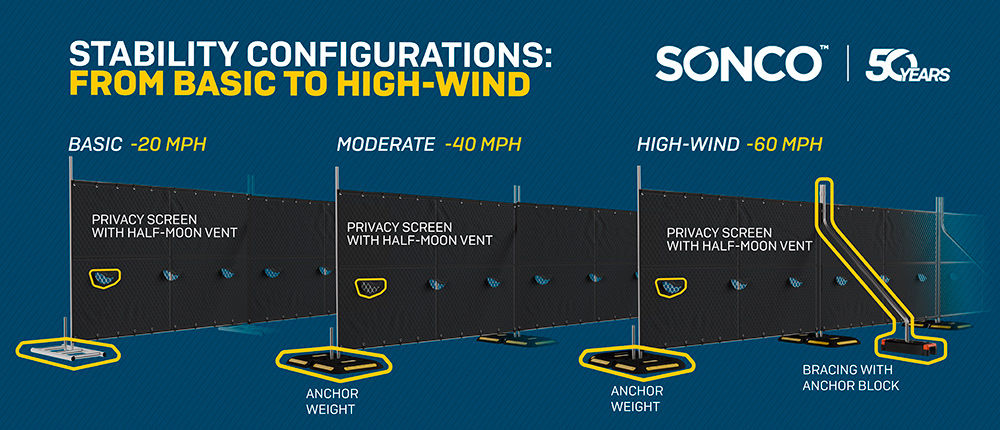
Stand a temporary fence panel up with nothing but a base under it, and it is rated stable in winds up to about 20 mph. Drop a single Anchor Weight on that base and the same panel holds to roughly 40 mph. Three Anchor Weights push that to near 60 mph, gale force on the Beaufort scale. The panel never changed. Only the foundation did.
“You can run the exact same panel and get three completely different results, depending on what’s holding it down,” says Andrew Hession, Temp Fence Specialist with SONCO, a leader in Crowd Control and Perimeter Security for 50 years.
Temporary Fence Stability Configurations at a Glance
- Basic, about 20 mph: the fence panel on its base alone.
- Moderate, about 40 mph: a single Anchor Weight added to the base.
- High-Wind, near 60 mph: three Anchor Weights, reinforced with bracing and an Anchor Block where the site demands it.
For contractors, the takeaway is simple: the same panel can perform three different ways, and the foundation decides which one you get on site.
What Holds a Temporary Fence Line: Tipping vs. Folding
A temporary fence fails in one of two ways: it tips over, or it folds along the run. They look similar from a distance, but each has a different cause and a different fix.
Tipping happens when wind catches a panel and rotates it off its base. Wind loads unevenly, and corners and ends take far more force, so weight belongs where it concentrates. A standard run gets Anchor Weights; corners and exposed stretches need the heavier footprint of an Anchor Block. The product follows the problem, not the other way around.
Folding is different. A long run behaves like a row of dominoes: one panel catching wind hands the load down the line until everything goes over, bases still planted. Weight won’t stop that; bracing will. Adding angled braces every 2 to 3 panels, roughly every 20 to 30 feet, breaks the run into segments and converts wind’s lateral push into a downward force the ground can resist.
Privacy Screen and Wind Load: Why Half-Moon Vents Matter
Privacy screen changes the equation entirely. Bare mesh lets wind pass through; solid privacy screen turns the fence into a sail. ASTM F3342 states screened fence should be engineered for wind load like a permanent structure.
The practical fix is allowing wind to blow through. Cleanly cut half-moon vents bleed off pressure before it builds. Cut by a professional, the wind vents hold. Cut on site, they tear and run.
Stacking Solutions: The Right Temp Fence Configuration for the Site
These solutions compound. Anchor Weights on standard runs, an Anchor Block at corners, bracing every 25 feet, and half-moon vents on any screened panel: that combination doesn’t add protection incrementally, it multiplies it. The right configuration isn’t one product; it’s the right stack for the site.
The Numbers Behind a Fallen Line: Anchor Weights vs. Sandbags
Sandbags and concrete blocks look cheap on the quote. The math says otherwise. A sandbag arrives as an empty bag and a pile of dirt. Crews shovel sand, haul it to position, place it, and repeat it on the next job. That time never hits the quote, but it hits payroll every deployment.
An Anchor Weight outlasts a sandbag tenfold and clears its own cost around the sixth deployment. An Anchor Block lasts roughly twenty times longer than the concrete block it replaces.
Temp Fence Stability Is a Spec, Not an Afterthought
The contractors who stopped getting the “wind-took-it-down” call stopped treating stability like a line item instead of a variable. Wind speed is only a starting point. Panel area, corners, and run length determine the real load. Build to that spec and stability stops being luck.
“Stability isn’t something you add after the fact. It’s something you engineer before anything goes in the ground,” says Stephen Greer, CEO of SONCO.
Treated as an afterthought, an unstable line is a liability waiting for the wrong day. Treated as a specification, it’s the difference between a fence that does its job and one that becomes the job.
Explore SONCO’s temporary fencing category to find the right equipment for your next project.
Trend now

Temporary Fence Rental Lifespan: Tips to Make Your Fence Last Longer
Learn the storage habits that extend the lifespan of every panel.

How to Manage a Crowd at an Event: A Complete Guide for Event Managers
Learn how to manage a crowd at an event with proven strategies for planning, signage, barriers, staffing and more.

How to Install a Mesh Chain-Link Fence: Step-by-Step Guide
Learn how to install a mesh chain-link fence step by step.
Search for category
Request a quote now! 