






The Stability Ladder: How to Start Renting Temp Fence with Confidence

Andrew Hession, August 14, 2026
Read more about the author


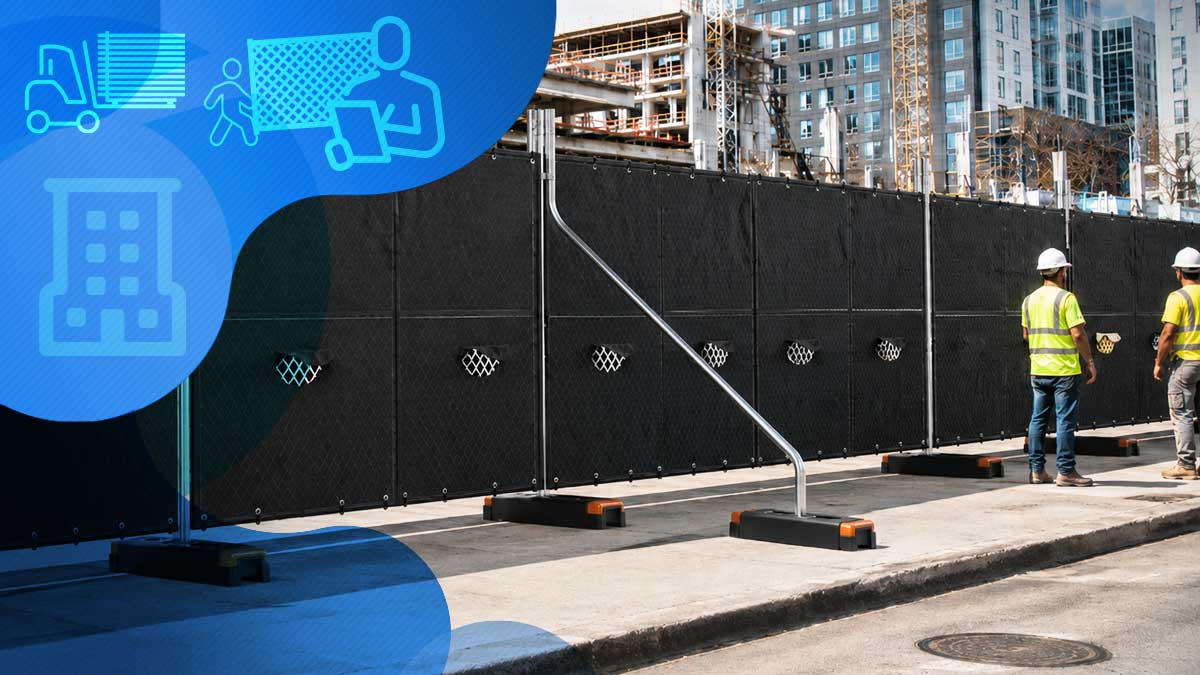
If your rental company doesn't currently offer fence screens with Temp Fence panels, wind is probably the reason. It's the most common objection I hear from operators considering whether to add it to their fleet: What happens the first time a storm rolls through and takes a line down?
Somebody has to reset it, and if it went down because the screen was hung without the right support, that's not a quick fix.
It's a fair question, and the good news is that this is one of the most preventable problems in the business. Temp Fence stability isn't one decision. It works in tiers, and every rental operator, even one starting from zero, can begin at the basic tier and build up as their job book demands it.
How Temp Fence Wind Ratings Actually Work
The question I get from new partners almost always sounds like some version of: What's the wind rating on this fence? What can it actually hold up to?
Here's the honest answer: there isn't one number. It depends on the height of the fence, whether it's screened, how the line is laid out, how many panels are connected together, and the site
itself. Anyone promising you a flat wind rating on a temp fence panel is oversimplifying it. The real answer is always "it depends," and knowing what it depends on is what separates a fence line that survives a storm from one that doesn't.
Why Privacy Screen Changes Temp Fence Wind Resistance
A bare chain-link panel lets wind pass straight through it. The moment you hang privacy screen across that panel, you've built a sail. It's a flat surface, standing vertically, doing exactly what a sail is designed to do: catch wind. That's what creates the sail effect, and it's what makes a screened line so much more likely to go over than a bare one.
Traditional stands hold up a bare Temp Fence in almost every case, short of a natural disaster or a genuinely major storm. Screen is what changes that. Once a new rental partner understands this distinction, the whole conversation shifts from "is temp fence reliable" to "how do we stock the right support for a screened line."
The Three Tiers of Temp Fence Stability
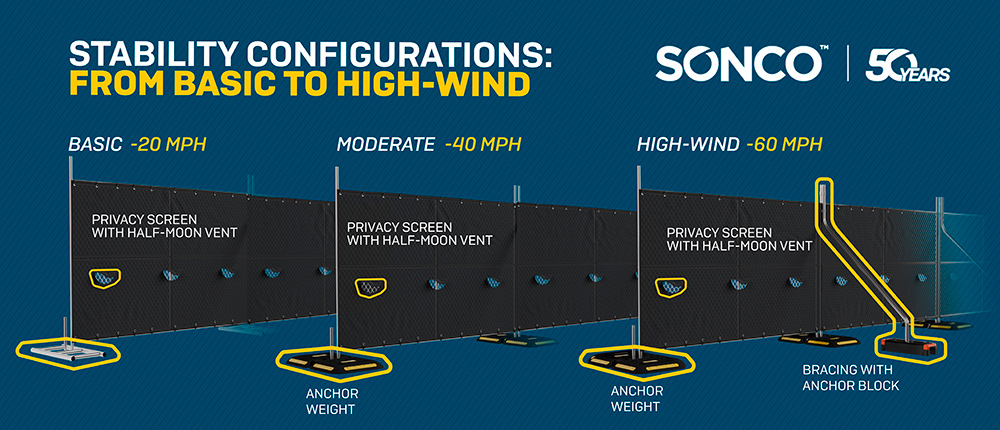
There's no single product that solves wind resistance. It's a set of tools, and a rental company doesn't need to stock all of them on day one. Picture the same fence panel, same privacy screen, same half moon vent, tested at three levels of support.
- Basic setup, rated to around 20 mph. Privacy screen with a vent, sitting on a standard metal tube base, with no added weight. This works for low exposure sites: short runs, sheltered areas, calmer regions. If you're new to temp fence rental, this is a reasonable starting inventory.
- Moderate setup, rated to around 40 mph. Add an anchor weight to that same base. Nothing else about the panel changes. The wind threshold nearly doubles because the foundation, not the fence itself, is what determines stability. This is the tier I don't negotiate on: if there's screen on the line, it needs an anchor weight or something anchoring it, full stop, regardless of how the run is laid out.
- High-wind setup, rated to around 60 mph. Keep the anchor weight along the run, and add bracing anchored with an anchor block at corners and exposed ends, roughly every 2 to 3 panels. This tier gets a standard panel to gale-force resistance on the Beaufort scale, without changing anything about the fence or screen itself.
The panel never changes across all three tiers. Only the foundation does. That's the fact worth considering if you're deciding whether Temp Fence with privacy screens is worth stocking at all. It's not a choice between safe and risky. It's a choice of how far up the tiers a given job requires, and you can scale your inventory the same way you scale your job book.
Note: The most effective way to combat wind is to drive a post into the ground and clamp the fence panel to it, providing direct support from the ground. When a site allows posts to be driven or holes to be dug, this is the strongest option. However, many jobs do not permit ground penetration, which is where stabilizer kits and anchor blocks provide a practical alternative for creating a secure, free-standing fence line.
Where Real Stability Comes From
Of the three stages, the stabilizer kit is the one that does the most work, and it's worth understanding in detail. It's an angled brace anchored to a heavy block, attached with a connector clamp, and added every 2 to 3 panels along the line. It fills the space between a bare weighted base and a fully driven post, which is exactly the space most Temp Fence jobs occupy.
Before stabilizer kits existed as a rental accessory, crews solved this problem by "burning" a panel: angling a spare panel off the line purely for support. It worked, but it used linear footage the company couldn't bill for. A stabilizer kit does the same structural job as a rental asset instead of a giveaway, which changes the economics of every deployment in which it's used.
For a company new to temp fence, the stabilizer kit is also the growth lever. Corners and exposed ends carry far more wind load than a straight run, so a stabilizer kit at those specific points is what allows a line to hold in wind that would otherwise take it down. A rental company doesn't need to own dozens of them on day one. As jobs bring more corners or windier sites, adding stabilizer kits at those points is how the fleet grows to match demand.
Starting Small and Scaling Up
A company entering this category for the first time doesn't need a full warehouse of accessories before writing its first screened fence quote. Bases and anchor weights alone cover most standard runs and reach the moderate stage immediately. That's a sensible starting inventory.
As jobs bring corners, longer exposed stretches, or windier regions, stabilizer kits get added at those specific points in the line. Inventory grows the same way the job book does, one stage at a time, rather than all at once.
This approach also answers a common industry default: a blanket policy against renting screened fence at all. That policy usually isn't based on screen being unsafe. It's based on not having a staged plan for wind beyond the basic setup. Once that plan exists, refusing screened fence becomes the more expensive choice, because it turns away business a competitor will happily take.
Anchor Weights and Why They Beat Sandbags
If there's regular screen or privacy screen on a line, it needs an anchor weight or something anchoring it, regardless of how the run is laid out. That part isn't negotiable, and it's worth building into inventory before anything else.
Anchor weights outperform sandbags on cost, even though sandbags look cheaper up front. A sandbag arrives as an empty bag and a pile of dirt, and someone has to fill it, place it, and break it down on every job. That labor never shows up on the quote, but it hits payroll every time. An anchor weight is reusable, holds up over many deployments, and typically pays for itself in about six jobs.
Layout Matters, but It Isn't a Substitute
How a line is laid out changes how much wind force it absorbs, and this costs nothing to plan for. A long straight run down a road takes wind directly, with nothing supporting it laterally. The same fence set up as a perimeter, with panels on all four sides, has three sides bracing the one taking the hit.
Scale helps too. A long, interlocked run of panels behaves as one heavy structure rather than individual pieces, which gives it more built-in resistance. None of this replaces an anchor weight or a stabilizer kit. If there's screen on the line, it still needs both at the appropriate stage, no matter how well it's laid out.
Getting Started
There's no single product that solves wind risk on its own. The strongest approach is a staged one: a base and anchor weight for standard runs, and a stabilizer kit at corners and exposed ends once a job calls for it.
For a rental company deciding whether to offer fence screens with Temp Fence panels for the first time, that staged approach is the answer to the wind objection. Start with the basic and moderate stages to cover most jobs, and add stabilizer kits as the fleet takes on more challenging sites. The fence doesn't change from stage to stage. What's added underneath it does, and that's what makes the category safe to enter.
Trend now

Temporary Fence Rental Lifespan: Tips to Make Your Fence Last Longer
Learn the storage habits that extend the lifespan of every panel.

How to Manage a Crowd at an Event: A Complete Guide for Event Managers
Learn how to manage a crowd at an event with proven strategies for planning, signage, barriers, staffing and more.

How to Install a Mesh Chain-Link Fence: Step-by-Step Guide
Learn how to install a mesh chain-link fence step by step.
Search for category
Request a quote now! 